Prompting
3 min read
October 20, 2026

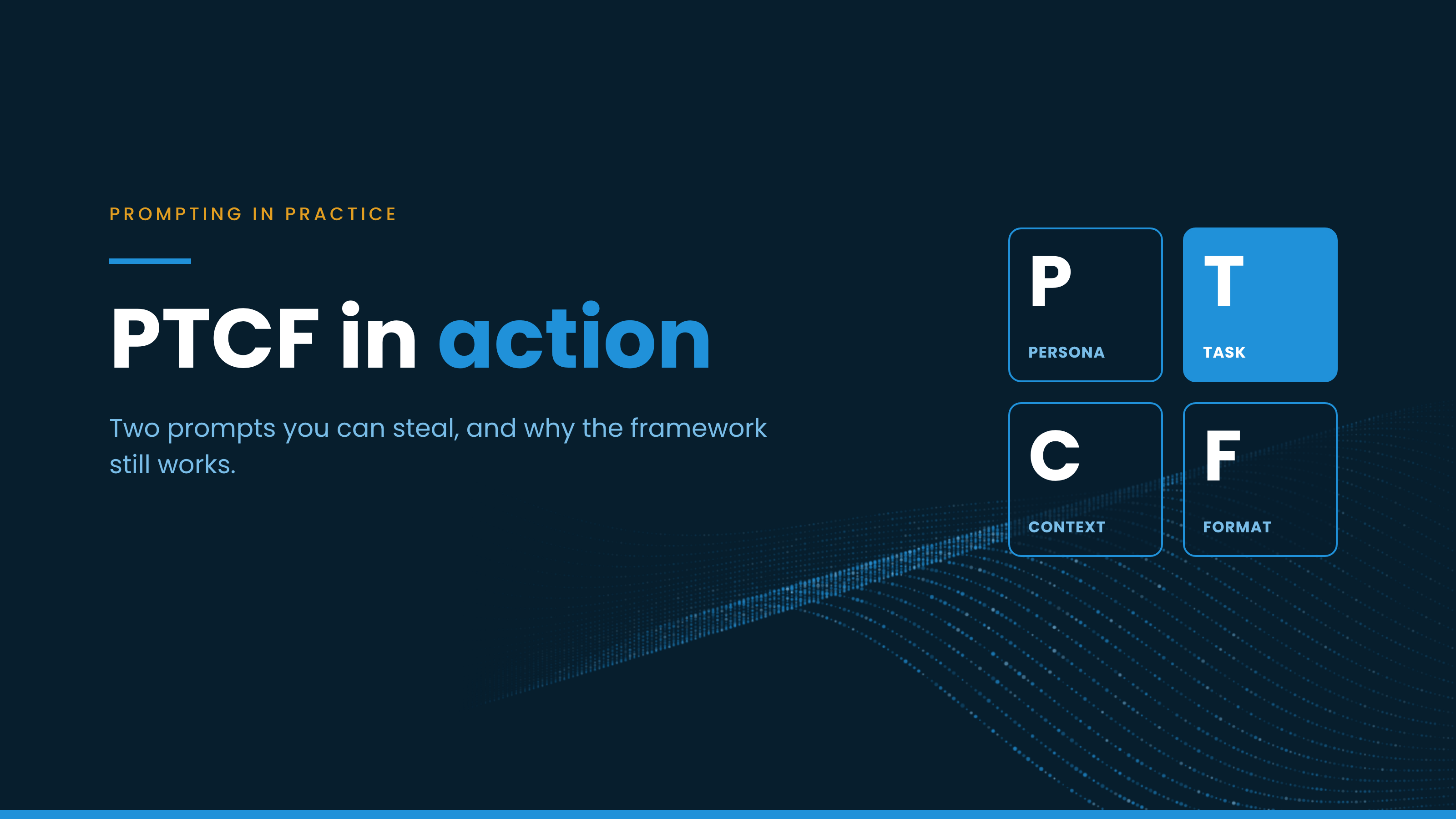
Prompting frameworks are pretty handy. We’ve spoken about some of those we use to train clients before, and PTCF (Persona, Task, Context, Format) is still our go-to.
In this article, we’ll help you move past the theory we’ve covered previously and look at what PTCF looks like in action. We’ve also included a couple of prompts you can test out.
But first, a quick refresher on the four components:
You don't have to include all four every time. Each one is something you can choose to add. Consider how important each one is to your end result, and go from there.
We run a lot of training for newsrooms, so here's an example from that world. Say that a journalist wants a research brief on a topic before they start reporting. The simple prompt of, "What are the key issues around the Brisbane 2032 Olympics?", will get a confident answer stitched together from whatever ranked well in a search. Some of it may be credible and some of it not.
Now, the same request as a PTCF prompt:
"You're a research assistant who only uses authoritative sources and flags limitations honestly (Persona). Outline the key issues and debates around the Brisbane 2032 Olympics (Task). I'm preparing background before reporting, so prioritise government bodies, universities and established news organisations, and don't smooth over anything you can't verify (Context). End with a limitations note covering any gaps or sources with a commercial or political interest in the topic (Format)."
In this case, including all the PTCF components will lead to a more accurate and effective output. The persona guides the response, the context tells it what to prioritise and what to admit, and the format forces a self-audit on the task before you see the output.
Here's another example that is useful for almost any professional – a start-of-day briefing built from your own calendar and inbox:
"You're a personal work assistant: concise, organised, working only from what you can see (Persona). Review my calendar and emails and give me my daily briefing (Task). It's the start of my working day. Don't make assumptions or fill gaps with general advice (Context). Use these headings: Urgent, Meetings, Outstanding Actions, Can Wait (Format)."
The context line does two jobs here, outlining the situation and telling the model what not to do. If you use AI regularly, then you’ll know that "don't fill gaps with general advice" is doing more work than it seems and will save you time on the edit. With a vague prompt, an AI often pads a thin answer with fluff.
The framework keeps you involved: you're the editor
One way to think about PTCF is as a briefing you'd give a capable new hire. You wouldn't say "here’s this report, have at it" and walk off. You'd tell them how to approach it, exactly what you need, any background they're missing, and how you want it delivered.
That's Persona, Task, Context, Format.
You don’t need the framework every time – a quick question is fine as a quick question. But when you need a quality output for a more high-stakes task – a client summary, a research brief – run the checklist.
In short, don't make the AI guess when you don’t have to.
Both prompts above are yours to steal. Just tweak them to fit a problem you're facing right now, and see the difference. Want to get better at prompting? Sign up for the AITC Dispatch and get next month's edition here.