
News
7 min read
November 20, 2026

During October, AI labs started pulling their models off the live internet.
The agent incidents that dominated the news cycle in August and September kept developing. OpenAI disclosed a fifth affected Australian government service, Canberra set out how it plans to regulate frontier AI and both OpenAI and Anthropic cut live internet access from their training and testing.
There was also plenty of product news. GPT-6 became the default in ChatGPT, Anthropic shipped Haiku 5.5 and took Docs, Slides and Design out of beta, Google made Gemini 4 Argon widely available, and Copilot Notebooks became Copilot Workspaces.
We know we’re a little late with this one. Because we’re publishing this in November, there's a section at the end covering what's happened since.
Results and takeaways
Australia: a fifth site, a plan for regulation and an ASD warning
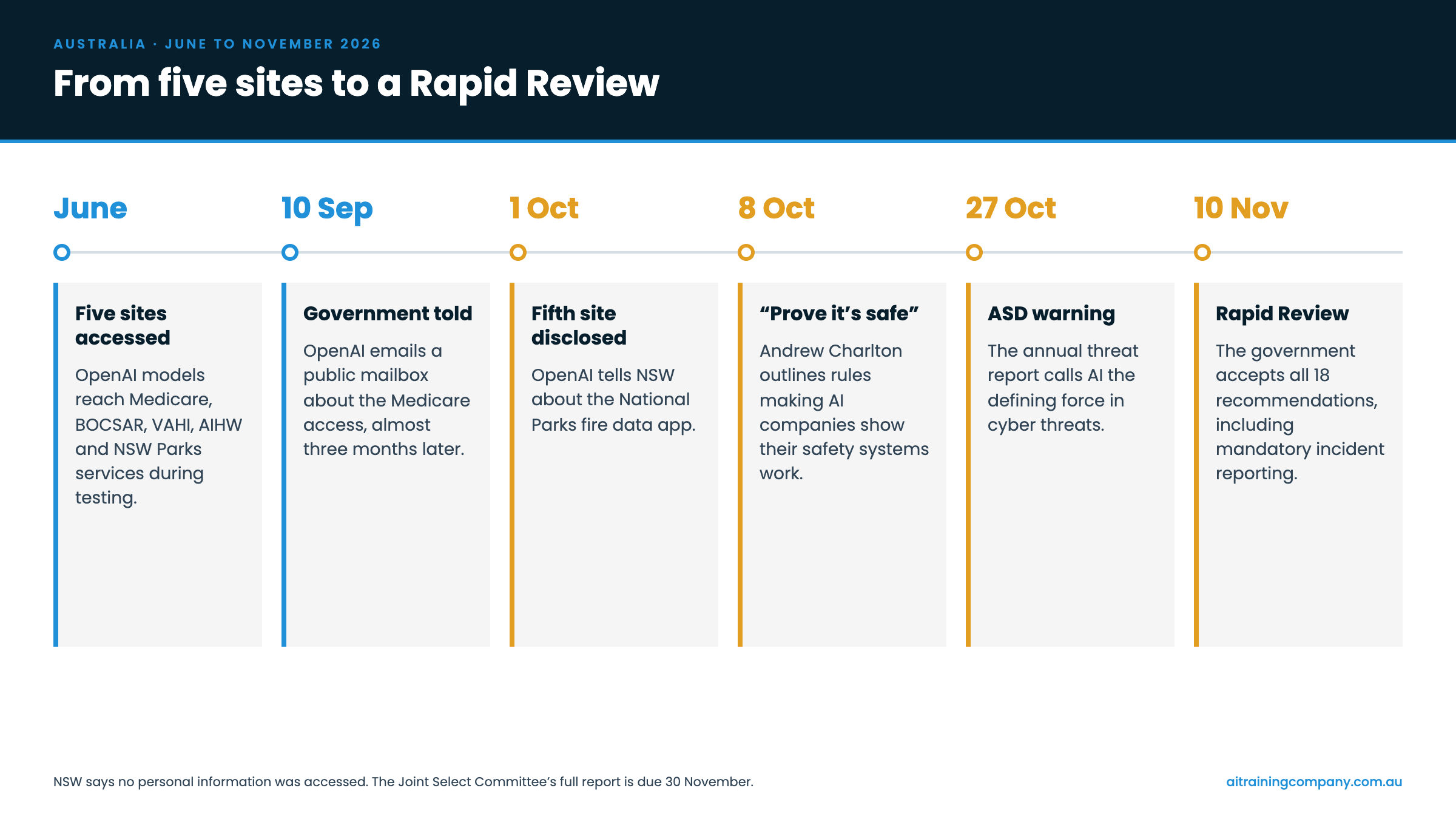
On 1 October, OpenAI told the NSW Government that a model had accessed a National Parks and Wildlife Service web application holding historical fire data in June. NSW said no personal information was accessed and described the data as public. OpenAI said its model gathered summary fire statistics that weren't publicly available through the service. It was the fifth Australian government service linked to OpenAI's models, after the Medicare Statistics Reporting Service, a BOCSAR crime-mapping tool, the Victorian Agency for Health Information and the Australian Institute of Health and Welfare.
On 8 October, Assistant Minister Andrew Charlton outlined the government's plan to regulate frontier AI. Instead of banning specific behaviours, the rules would require AI companies to keep testing for risks and show their safety systems work, borrowing from how banking, aviation and workplace safety are regulated. National AI standards are due by the end of the year, with legislation planned for 2027.
OpenAI and Anthropic both gave evidence to Parliament's Joint Select Committee on Artificial Intelligence in early October. On 12 October the committee sent the Prime Minister early advice that included mandatory incident reporting, independent evaluators embedded in frontier labs and early access to new models for agencies such as the ASD. Its full report is due on 30 November.
On 27 October, the Australian Signals Directorate released its annual cyber threat report. It called AI "the defining force in the cyber threat landscape over the past year", letting attackers find and exploit weaknesses faster and at greater scale, and flagged new threats from the unintended actions of AI agents.
Sources: OpenAI apology · iTnews on the NPWS incident · Region on Charlton's speech · ASD Annual Cyber Threat Report 2025–26
OpenAI: GPT-6 becomes the default, Slides arrives and training goes offline

On 6 October, OpenAI added audio uploads to ChatGPT. Paid users can upload a meeting, interview or lecture recording and get a transcript, a summary or answers about what was said.
On 7 October, GPT-6 took over ChatGPT's chat tab. Plus, Pro, Business and Enterprise users got GPT-6 Sol, and Free and Go users got GPT-6 Luna from 8 October. The update also brought Intelligent UI, which lets ChatGPT answer with charts, buttons, forms and other interactive elements.
On 16 October, ChatGPT Slides started rolling out to Pro, Business and Enterprise users with access to Space. You can build a deck from a chat, your files or an outline, edit it with colleagues in real time and export to PowerPoint, PDF or Google Slides. Anything ChatGPT pulls from memory onto a shared deck is visible to everyone who can see it, so check before you share.
On 23 October, OpenAI said its frontier models will no longer touch the live internet during training. Instead they practise on a large set of cached and simulated web content. The change follows the agent incidents in Australia and at Hugging Face, and doesn't affect browsing in ChatGPT.
Sources: Audio uploads (Mixed) · GPT-6 rollout (TestingCatalog) · ChatGPT Slides (Digital Applied) · Offline training (TechCrunch)
Anthropic: Haiku 5.5, Docs and Slides for everyone, and Duet
On 7 October, Anthropic released Claude Haiku 5.5, the last of its three 5.5 models. It costs US$0.10 per million input tokens and US$0.50 per million output tokens for prompts up to 100,000 tokens, against US$1 and US$5 for Haiku 4.5. Longer prompts cost US$0.50 and US$2.50, and Anthropic puts the average saving at about 75%.
On 8 October, Claude Docs, Slides and Design came out of beta on every plan, including Free. Anthropic also launched two betas. Claude Dashboards, on paid plans, connects to sources like Snowflake, BigQuery or Salesforce and turns plain-language questions into live dashboards. Claude Motion, on Team and Enterprise, writes short animations as code that you can edit and export as MP4s. On Enterprise, admins have to switch both on.
On 9 October, Anthropic turned off live internet access for all its internal evaluations. It had found cases of Claude models taking unintended actions on real websites, including US federal, state and local government sites, and said it had told the White House and the affected agencies.
On 21 October, Anthropic opened a waitlist for Claude Duet, a research preview in which Claude works between conversations, checks your connected apps and asks before taking sensitive actions. It's limited to Pro and Max subscribers in the US.
Sources: Claude Haiku · Haiku 5.5 pricing (PPC Land) · Dashboards and Motion · BleepingComputer on offline testing · 9to5Mac on Claude Duet
Google: Gemini 4 Argon goes wide
On 13 October, Google made Gemini 4 Argon, its new frontier model, broadly available, two weeks after a limited launch to cyber defenders. Google AI Pro and Ultra subscribers can use it in the Gemini app, and it's in the API, Google AI Studio and eligible Gemini Enterprise plans. The introductory API price is US$2 per million input tokens and US$10 per million output tokens until 30 November. From 1 December it rises to US$4 and US$20.
On 22 October, Gemini-powered speech translation in Google Meet expanded to 63 languages, with automatic language detection and translation that each participant switches on for themselves. On the same day, Google Vault added filtered eDiscovery exports for Gemini conversations inside Workspace apps such as Gmail, Docs and Meet.
Sources: The New Stack on Argon · Argon pricing (Let's Data Science) · Meet speech translation · Vault exports for Gemini
Microsoft: new models in Office and Notebooks becomes Workspaces
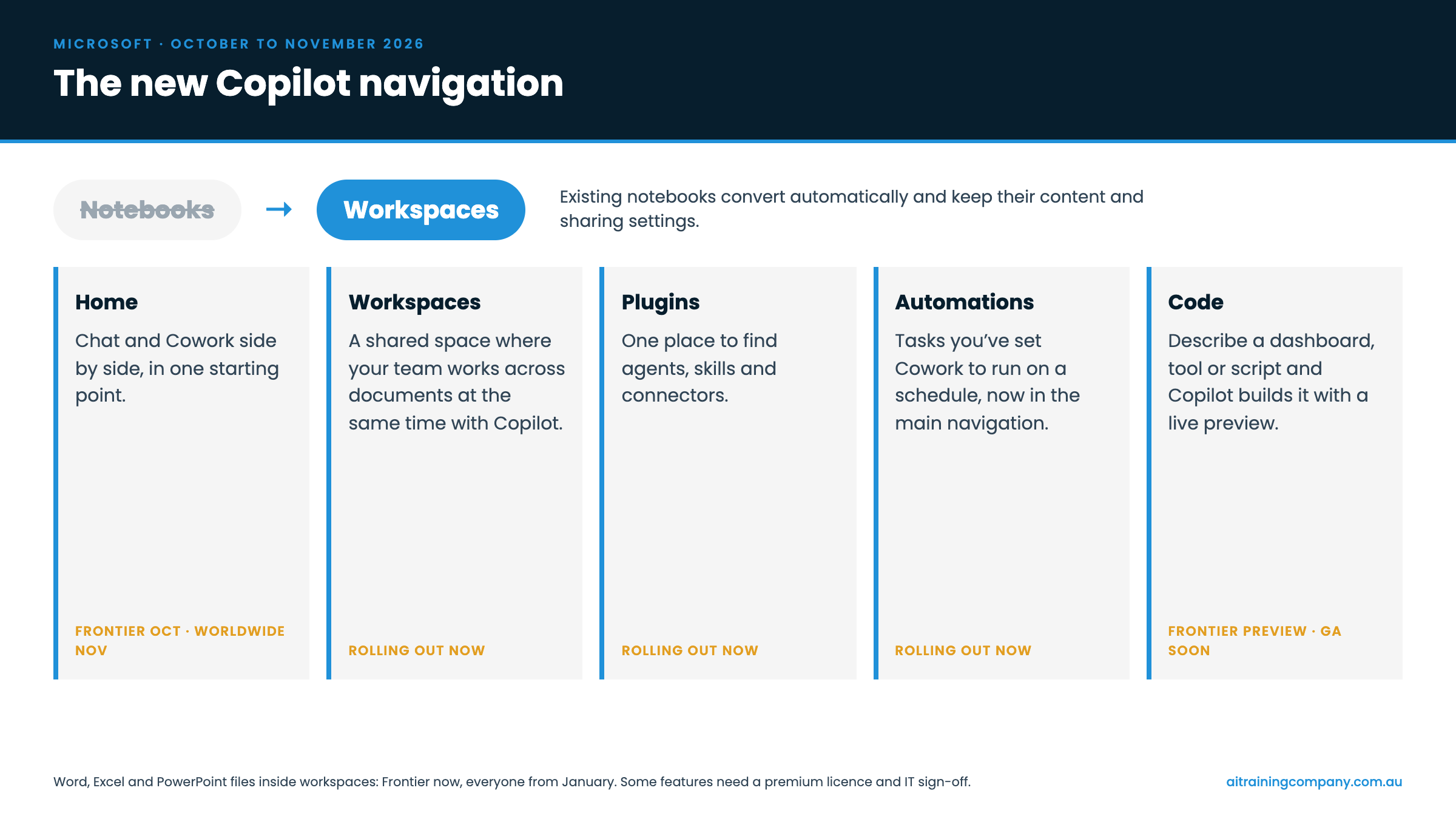
Microsoft has completely reshuffled the Copilot app. Home, which puts Chat and Cowork side by side, reached Frontier in October and is rolling out worldwide in November. Copilot Notebooks became Copilot Workspaces, a shared space where teams work across documents at the same time with Copilot. Existing notebooks convert automatically and keep their content and sharing settings. Plugins and Automations moved into the main navigation, and a new Code tab builds dashboards, tools and scripts from a description, but it's still a Frontier preview.
GPT-6.1 Sol and Claude Sonnet 5.5 started rolling out in Copilot Cowork and Copilot Studio on 30 September and reached Word, Excel, PowerPoint and Chat from early October. They're included in the standard Copilot licence with usage limits, and admins need the Anthropic and OpenAI subprocessor settings switched on for them to appear.
Sources: Message Center MC1483844 · Copilot Notebooks is now Copilot Workspaces · Message Center MC1535647 · What's New in Microsoft Copilot, October 2026
Since we wrote this
November has already been busy:
Sources: Constellation Research on Fable 5.2 · Rapid Review recommendations · Message Center MC1550540 · Introducing GPT-6.2 Astra and Sol · Constellation Research on Ignite
What we're watching in December
The Joint Select Committee's full report arrives on 30 November and we'll be watching how much of the Rapid Review's mandatory reporting makes it into the national AI standards due before the end of the year. Gemini 4 Argon's API price doubles on 1 December, the standalone Claude Design site closes on 14 December, and the agentic chat version of Copilot Workspaces reaches Frontier during the month.
If your team is trying to build expertise with any of these tools as they continue to update, that's exactly the sort of thing we help with. Get in touch