
News
3 min read
August 22, 2026

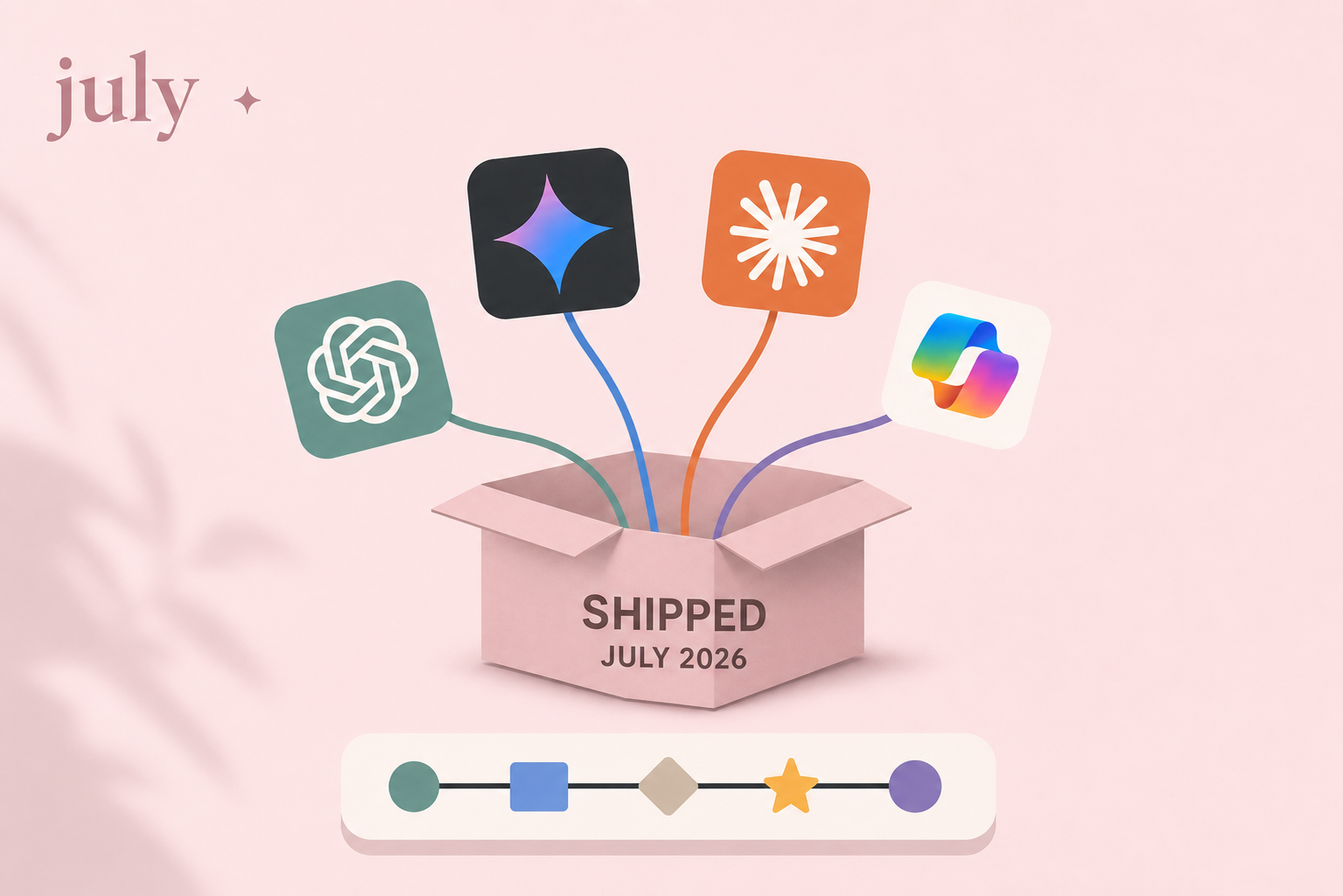
June was about policy catching up with product. July was about the big labs sorting out who actually gets access to what, and at what price. Sonnet 5 became the default for most Claude users, the Fable 5 saga finally landed somewhere, OpenAI put GPT-5.6 in everyone's hands, and Google shipped three Gemini models while pointedly skipping the one everyone was waiting for.
Here's the short version, followed by the detail.
Results and takeaways
Anthropic: Sonnet 5 becomes the default, and Fable 5 settles
Claude Sonnet 5, released 30 June, became the default model for Free and Pro users on 1 July. It's the most agentic Sonnet yet and, on many tasks, performs close to the flagship Opus 4.8 for a lot less money. Introductory API pricing of US$2 per million input tokens and US$10 output runs to 31 August.
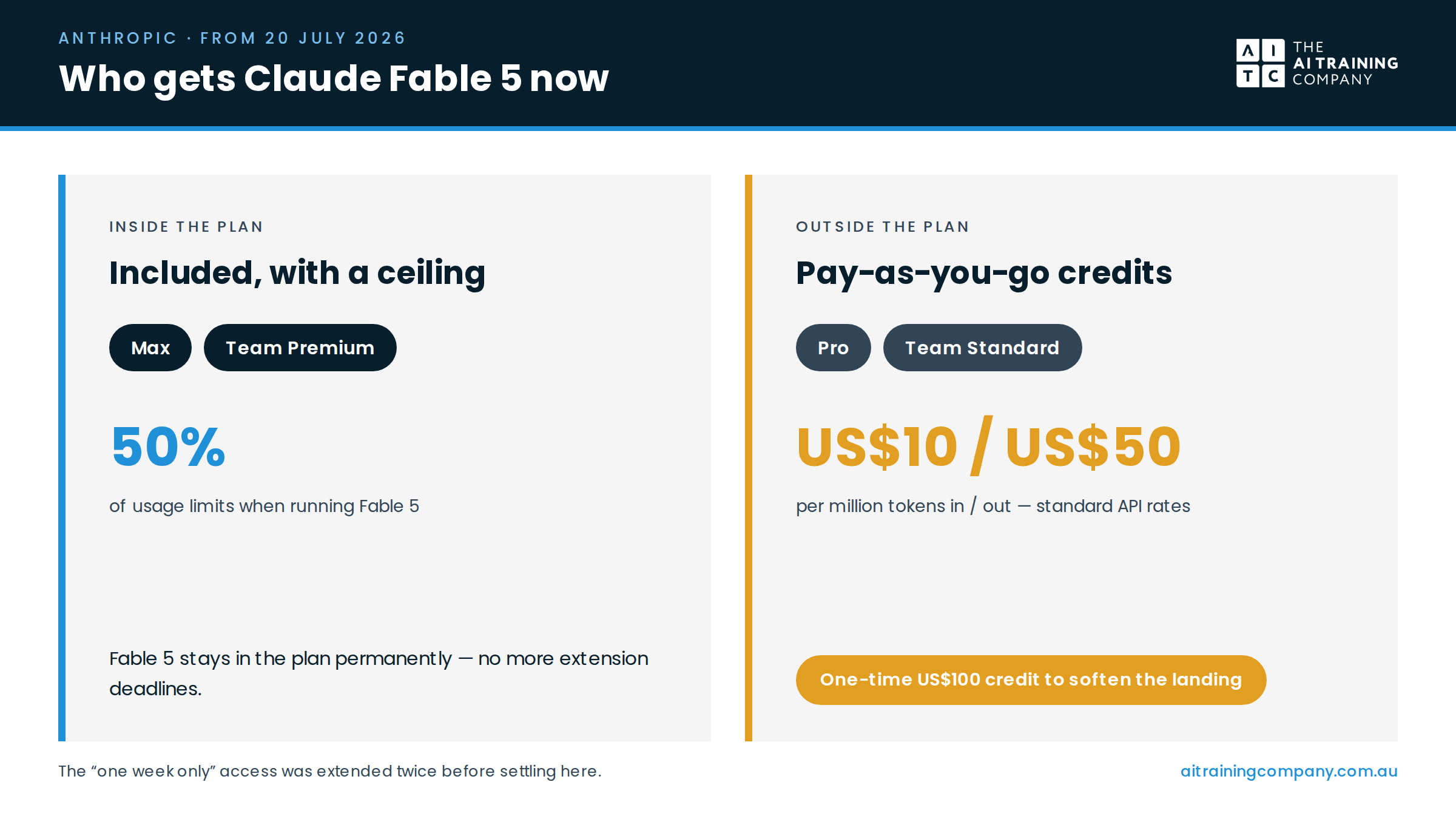
The Fable 5 story from last month also has an ending. The "one week only" access got extended twice, first to 12 July, then to 19 July. From 20 July, Fable 5 stays inside Max and Team Premium plans at 50% of usage limits. Pro and Team Standard users don't get it within their plan and have to reach it through usage credits at standard API rates (US$10 input / US$50 output per million tokens), though there's a one-time US$100 credit to soften the landing.
Google: three new Gemini models but no 3.5 Pro
On 21 July, Google DeepMind announced Gemini 3.6 Flash, 3.5 Flash-Lite and 3.5 Flash Cyber. Two of the three shipped that day. 3.6 Flash was the new workhorse: it uses 17% fewer output tokens than 3.5 Flash, and up to 65% fewer on long-horizon agentic tasks, while undercutting its predecessor on price. Flash-Lite is the cheapest of the group at US$0.30 input / US$2.50 output. Flash Cyber, tuned for finding and fixing security vulnerabilities, didn't go on general release at all. It went to a limited pilot for governments and trusted partners through CodeMender.
The conspicuous absence was Gemini 3.5 Pro. It has now missed three launch targets: late June, 17 July and early August. Bloomberg reports coding performance is the hold-up. Google keeps shipping Flash models while the flagship sits in enterprise preview.
Microsoft: Copilot consolidates and fights for paying users
M365 Copilot's steady stream of updates rolled on. You can now build Word, Excel and PowerPoint files straight from SharePoint content. You can also publish admin-reviewed agents to the Agent Store and switch on watermarks for AI-generated video and audio. Copilot Notebooks came to OneNote on web and iOS, with mind maps for navigating notebook content. Separately, Audio Overview in Word picked up real-time voice, so you can interrupt and ask questions while it's playing.
The bigger news: Microsoft is merging its Copilot apps into one. Recon Analytics data on US paid subscribers has Copilot falling from 18.8% to 11.5% between July 2025 and January 2026, with Gemini passing it in late November. At the enterprise level we suspect it's still holding up well, but the consumer contest just got real.
OpenAI: GPT-5.6 goes public
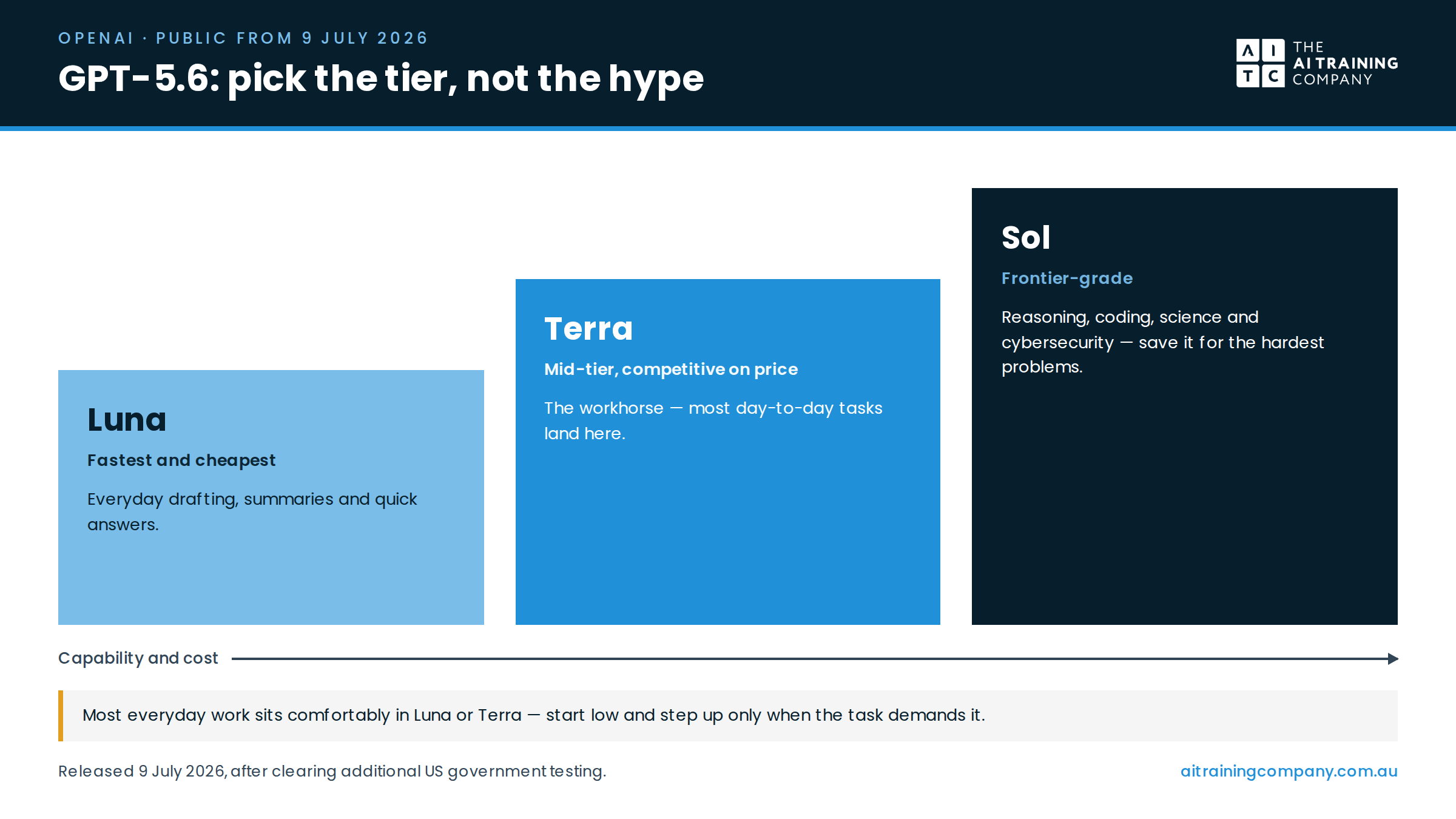
After last month's limited preview, OpenAI released GPT-5.6 to the public on 9 July, once it cleared additional US government testing. There are three variants, least to most capable: Luna (fastest and cheapest), Terra (mid-tier and competitive on price) and Sol (frontier-grade reasoning, coding, science and cybersecurity). Most everyday work sits comfortably with Luna or Terra, with Sol reserved for the hardest problems.
The pattern
This month was about access and price more than raw capability. Frontier models are getting cheaper to run and the tiers keep multiplying. The labs are working out how to keep power users happy without giving the good stuff away. For most teams the practical question is which tier a task actually needs, rather than which model is smartest.
What we're watching in August
In August we're watching whether Gemini 3.5 Pro finally arrives and how the single merged Copilot app lands with users. We're also watching whether Sonnet 5 at Free-tier pricing shifts the day-to-day habits of the people we train.
If your team is trying to work out which of these actually matters for the work you do, that's exactly the sort of thing we help with. Get in touch!