
AI
5 min read
June 11, 2026

Data centres are maxed out. A token drought may be imminent. So in May, a lot of conversation in AI land was focused on speed and efficiency.
Google launched Gemini 3.5 Flash at I/O on 19 May, claiming it was 4× faster than any rival model. But the model was met with mixed reviews. Some users complained that Gemini 3.5 Flash suffered from severe token quota limits, high hidden costs and broken coding workflows. Google has already responded by introducing a lower-latency, low-token model variant to help ease these restrictions.
On the other end of the spectrum, Anthropic released its upgraded Opus 4.8 model in May. This is a frontier model that is highly capable, but its most commented-on feature is honesty - Opus 4.8 tells you exactly what it thinks. This has annoyed some users, but here at AITC we say any move away from sycophancy is for the better.
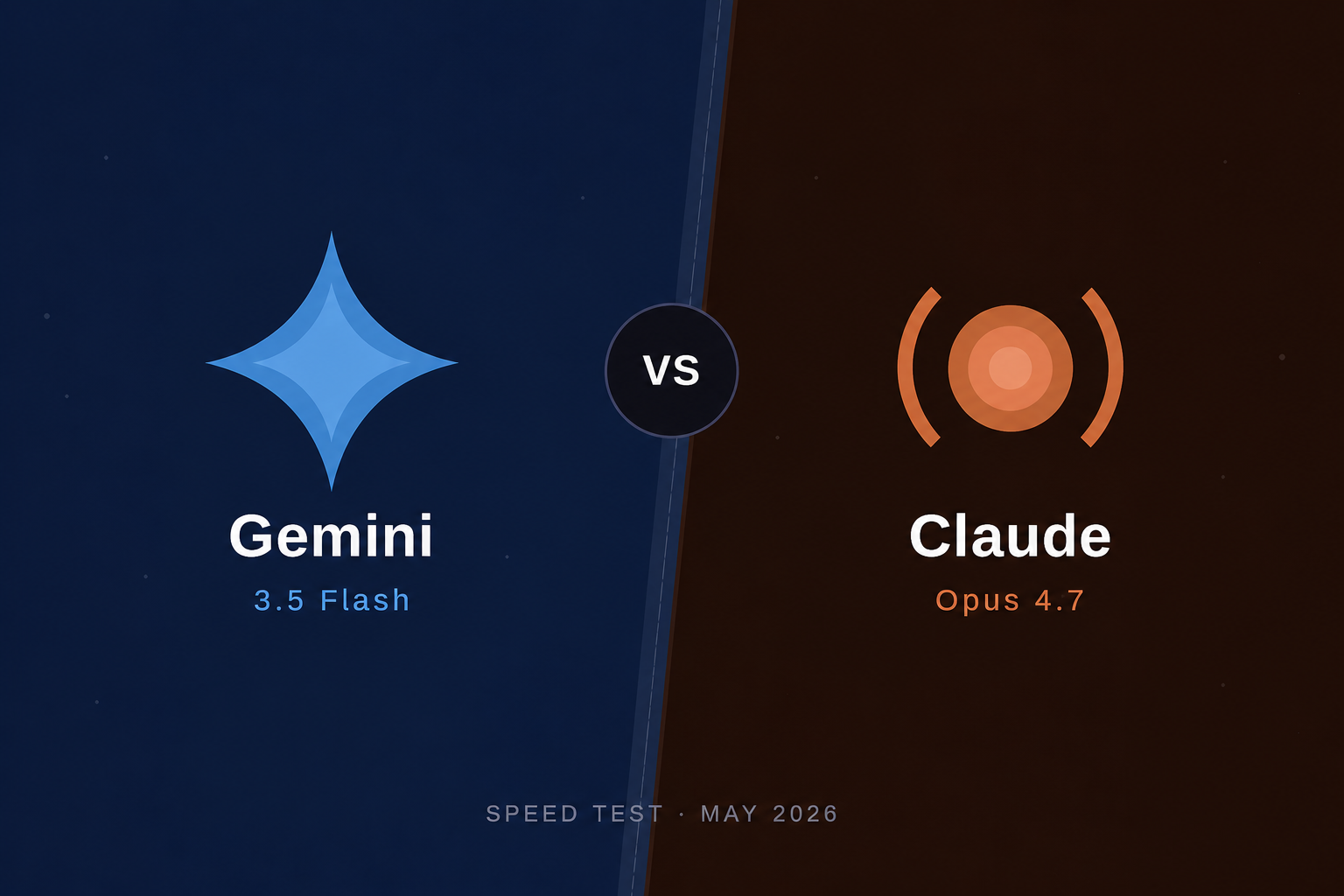
As a special feature for this month’s newsletter, we put Google's claim to the test against Claude Opus 4.7 (this was prior to the 4.8 release). A
Google launched Gemini 3.5 Flash at its developer conference, I/O, on 19 May 2026. The claim: it’s 4× faster than all other frontier AIs. To test this out, we gave it three practical business tasks, alongside Claude Opus 4.7 (the first port of call for AITC right now). We wanted to see if the speed of Flash 3.5 could shake up that workflow.
THE MODELS
Gemini 3.5 Flash
Launched 19 May 2026. Designed for speed and multi-step agentic tasks. Available in the Gemini app and Google Workspace, with native integration across Slides, Docs, and Search. API: $1.50 input / $9.00 output per million tokens.
Claude Opus 4.7
Launched April 2026. Strong across writing, code, analysis, and long-horizon tasks. Available via Claude.ai, Amazon Bedrock, Google Cloud, Microsoft Azure. API: $5.00 input / $25.00 output per million tokens.
Here are the three tests and the exact prompts we used. You can take them and play around with the tools yourself.
01 Presentation deck
"Create a 10-slide presentation on how Australian small businesses can use AI to save time and compete with larger competitors. Include a title slide, an agenda, practical examples, and a summary."
02 Data visualisation app
"Build an interactive HTML dashboard that shows AI tool adoption rates across Australian industries. Include at least one chart, a trend indicator, and a simple ROI calculator for a training investment."
03 Training curriculum
"Write a full-day AI literacy training programme for a 15-person retail team. Include learning objectives, session outlines (morning and afternoon), at least two hands-on exercises, and a post-session evaluation guide."
Gemini 3.5 Flash (~49s): Gemini decided to take the initiative and pull live market data into the deck, which it generated in 18 seconds, though it took another 31 seconds to render and open. There were a few accuracy issues, like the use of US "SMB" terminology, a generic placeholder in the footer, and some small visual errors like text overlap.
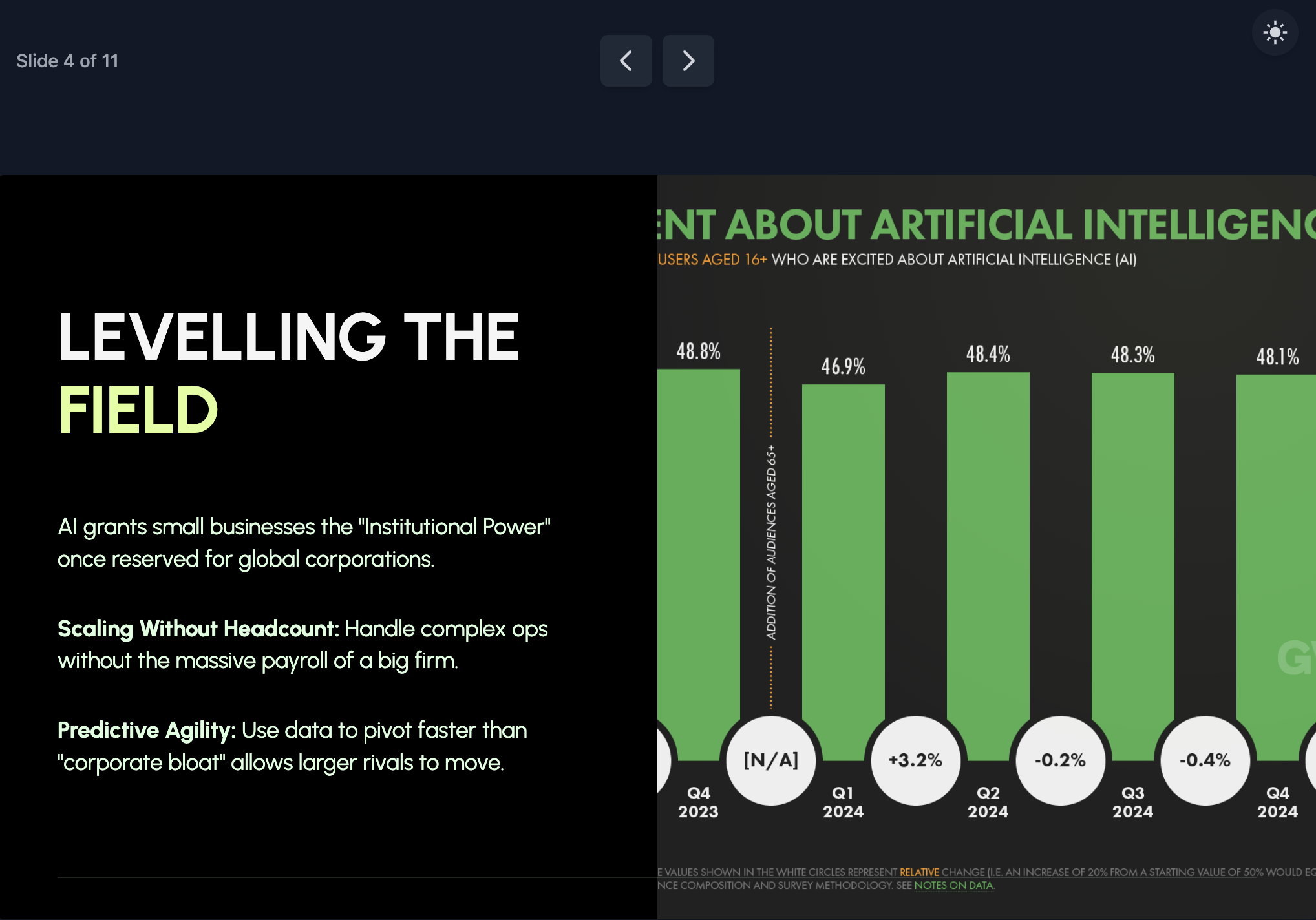
Claude (~1m 50s): Operating as an agent, Claude wrote a custom script and generated a 10-slide .pptx file immediately. The deck included correct, localised SME terminology without any placeholders or visual errors.

AITC verdict: Claude wins on portability and accuracy. The time saved on output generation by using Gemini is won back by Claude's simple export, reliable formatting and relevant language. Gemini's speed and live data are impressive, but a reliable output is worth waiting a little longer for in most business contexts.
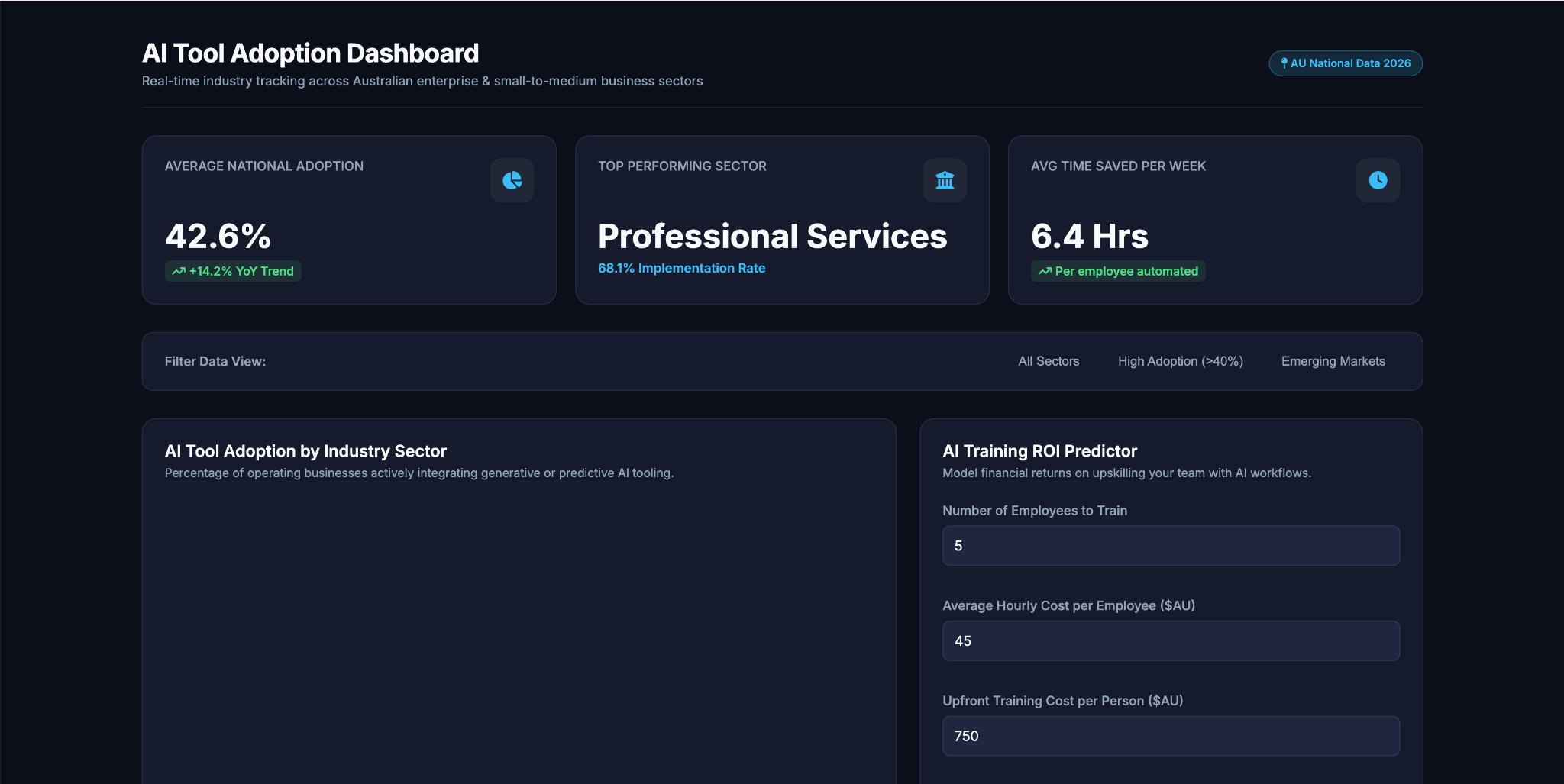
Claude (~58s): Built a self-contained, working HTML dashboard featuring an industry adoption chart, trend lines and an ROI calculator. It looked great and provided an in-app preview that made the review process much easier than downloading and reopening a file.
Gemini 3.5 Flash (~6.2s): Built a simple, working HTML file with CSS transition animations, a dark mode aesthetic, and a JavaScript ROI calculator in just 6.2 seconds. It had no in-app preview, so there was some friction opening and checking the output.
AITC verdict: Gemini was rapid on this one. That’s fast. Claude takes points on user experience and workflow convenience.
Claude (~1m 57s): Delivered a dense, 7-session, production-ready programme with a 90-day evaluation framework and thorough facilitator notes. Outputs were specific to the prompt and a solid start for any training designer.
Gemini 3.5 Flash (~3.4s): Delivered a text-based syllabus organising staff into agile 3-person squads with some high-stakes simulations that seemed actually usable. Supplier crisis management was a highlight. Remarkably good for 3.4 seconds.
AITC verdict: Both were pretty generic, but that’s not unexpected given the basic prompt and lack of context. Claude wins on operational density and readiness. Gemini wins on speed and engaging structural frameworks.
Google's speed claims stand up to the test. It delivers rapid outputs at a consistently high quality. You can definitely see how a scaled business that wants good-quality outputs more rapidly and at lower token cost might consider using this model.
But for AITC, the larger agentic models like Claude are worth waiting around for - unless the token drought bites and we’re all rationing the big models. Then you could really see Gemini 3.5 Flash becoming a good choice for everyday business users. .
As always, if you'd like to learn more about the tools you and your team are using at work, send us a message.